
How Do You Know When to Add Weight?
Progressive overload is essential for getting stronger, but adding weight should be based on more than simply completing your reps. Learn how technique, effort, RPE, and daily performance can help you decide when to increase the load—and when to hold back.
A Practical Guide to Progressing Your Strength Training
One of the most common questions in strength training is also one of the easiest to overcomplicate:
When should I add more weight?
The obvious answer seems to be, “When the weight gets easy.”
But that leaves a lot unanswered.
How easy is easy enough? What if you completed every rep, but the last few looked terrible? What if the same weight felt great last week and unusually heavy today? Should you still add five pounds because the program says so?
Progressive overload is essential for continued adaptation, but progression should be driven by performance—not simply by the passage of time.
Adding weight is something you earn through your performance.
The Problem With “Just Add Weight Every Week”
Linear progression works extremely well in the right circumstances.
You perform the prescribed work, recover, adapt, and increase the load the next time around. For newer lifters, this process can sometimes continue for quite a while.
Eventually, however, progress stops being perfectly linear.
Sleep changes. Work gets stressful. Training volume accumulates. Nutrition varies. You have unusually good days and unusually bad ones. As you become stronger, the difference between an appropriate training load and an excessive one also becomes smaller.
This is where blindly increasing weight can become counterproductive.
A program may tell you what you are supposed to lift. Your performance tells you what you are actually prepared to lift.
Good programming accounts for both.
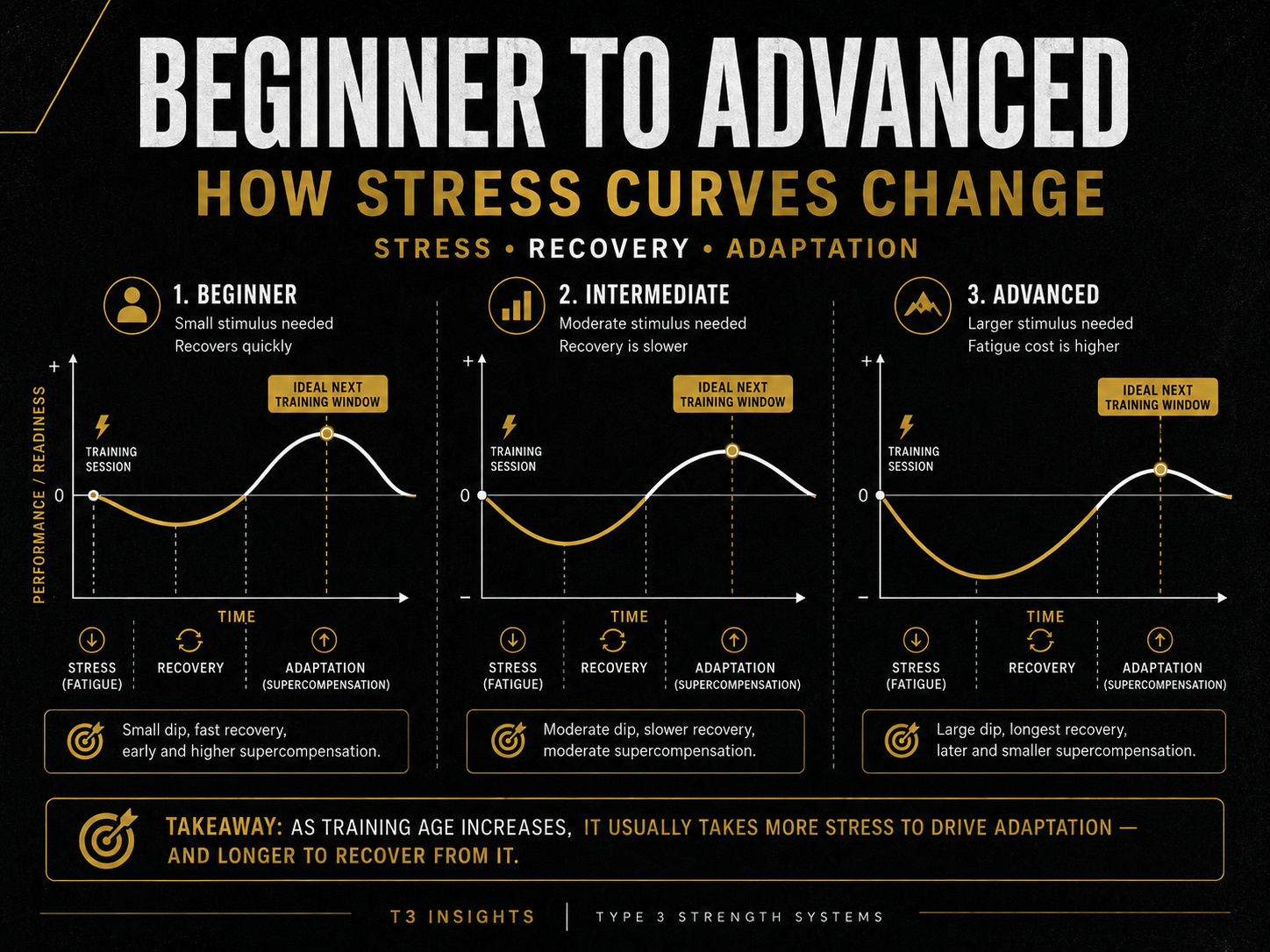
Following Selye’s SRA curve, bigger stressors requires more time to recover and adapt for greater improvements. Therefore, it is limiting to follow a strict linear progression and more effective to train in an auto-regulatory fashion.
Three Questions to Ask Before Adding Weight
Before increasing the load, look at three things:
1. Did You Complete the Prescribed Work?
Start with the obvious.
If the program calls for three sets of eight and you complete:
8 / 8 / 8
you have at least met the volume requirement.
If you instead perform:
8 / 7 / 5
there probably isn't a compelling reason to make the exercise heavier yet.
But completing the repetitions alone isn't enough.
There is a major difference between completing eight controlled repetitions and barely surviving the eighth repetition while technique deteriorates.
That's where the next two questions become important.
2. Did Your Technique Stay Consistent?
Load should challenge the movement without fundamentally changing it.
As fatigue increases, some technical variation is normal. The final repetition of a difficult squat probably won't look identical to the first.
But significant changes in technique are useful feedback.
If increasing effort causes you to:
Lose your brace
Shorten the intended range of motion
Change your position substantially
Use momentum that wasn't intended
Shift the movement away from the muscles you're trying to train
then adding additional load may not represent meaningful progression.
Moving more weight is only useful if you're still performing the exercise you intended to perform.
In many cases, improving execution at the same load is progression in itself.
3. Was the Effort Appropriate?
This is where concepts such as RPE — Rate of Perceived Exertion — become useful.
Two people can complete the exact same sets and repetitions with very different training responses.
Consider two lifters who both squat 225 pounds for five repetitions.
For the first lifter, the set is challenging but controlled and another two or three repetitions were probably available.
For the second, repetition five is an all-out effort.
They completed the same weight for the same repetitions.
They should not necessarily make the same progression.
This is one of the reasons we use autoregulation in strength training.
Rather than treating the planned load as absolute, we compare the intended training stimulus with what actually happened.
If a set intended to be moderately difficult becomes a near-maximal effort, adding weight simply because you completed the repetitions misses the point.
Performance Should Drive Progression
This idea is at the center of training autoregulation using RPE, bar velocity, and other subjective performance measures.
Instead of relying exclusively on predetermined 1RM percentages, auto-regulation relates to your readiness for the day to help determine subsequent training loads. But “performance” is more than just whether the reps were completed—it includes how they were completed.
One of the most useful additions to modern strength training is RPE (Rate of Perceived Exertion), which helps quantify how hard a set actually felt. A set of five reps at 225 pounds might be a 6/10 for one lifter and a 9/10 for another. Those are not the same training stimulus, even though the external load is identical.
RPE gives us a way to connect internal effort to external load:
RPE 6–7: Fast, controlled, several reps in reserve
RPE 8: Challenging but clean, ~2 reps in reserve
RPE 9: Very hard, ~1 rep in reserve
RPE 10: Maximal effort, no reps left
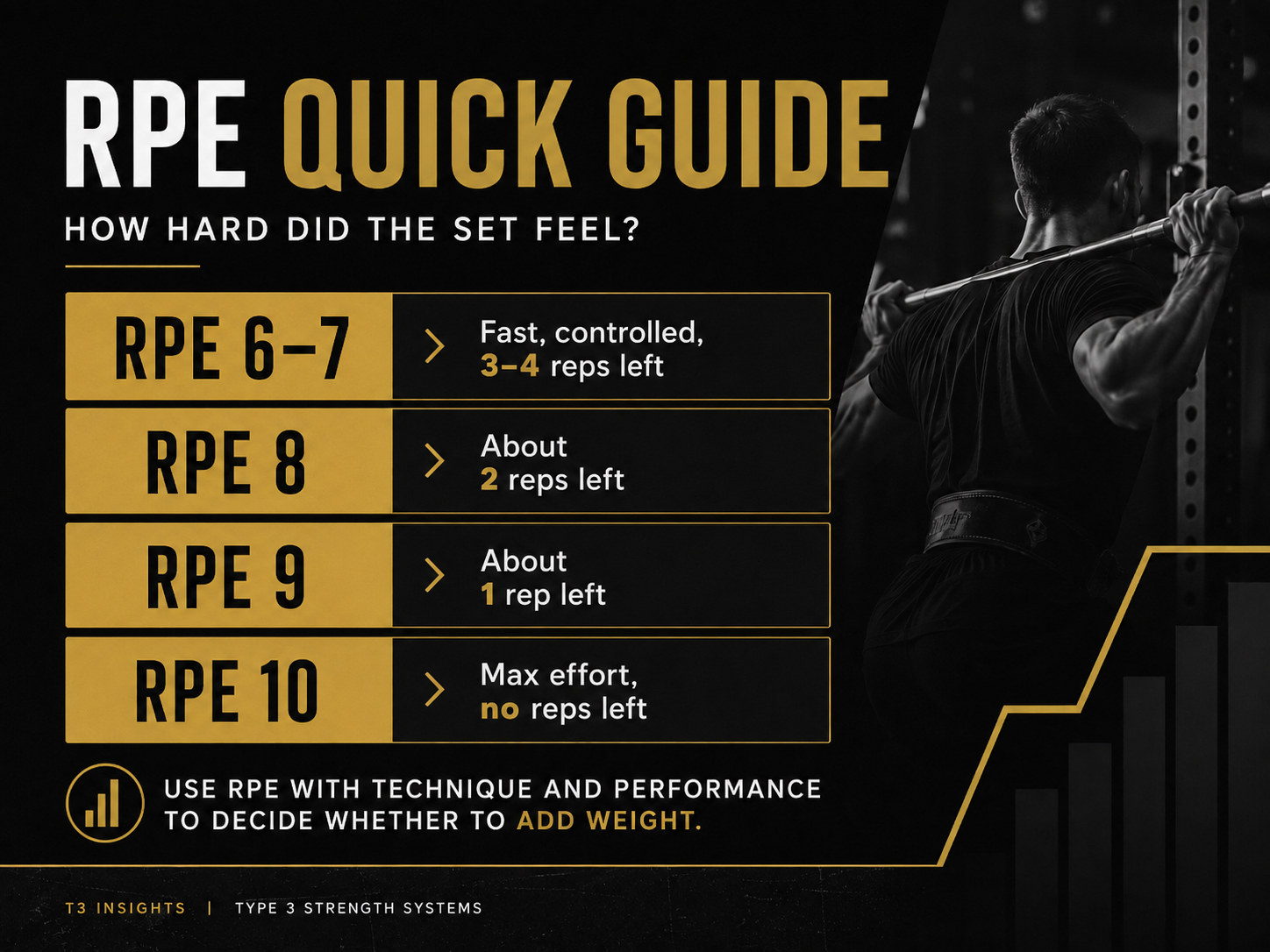
Tracking your RPE to match your training can greatly improve training outcomes rather than relying on 1RM relative loading alone.
When RPE is tracked consistently, it becomes a powerful decision-making tool. If a prescribed load was intended to be moderate but lands at an RPE 9 instead of an RPE 7, that’s a clear signal that progression should pause or adjust. Conversely, if a set feels easier than expected at a given load and RPE is lower than planned, that may indicate readiness to increase weight sooner.
Another increasingly valuable tool is bar velocity—either measured with devices or estimated through experience. While not required for effective training, velocity provides objective feedback on how quickly a load is moving. A bar that moves explosively at a given weight suggests higher readiness than a bar that grinds slowly under the same load.
Even without technology, lifters can develop a strong sense of “velocity awareness”:
Was the bar fast or slow off the chest or out of the hole?
Did every rep slow down significantly, or only the last one?
Did the set feel snappy or like a grind from the start?
These observations help refine load selection in real time.
When you combine RPE, bar speed, and subjective performance cues, you get a much clearer picture of readiness than percentages alone can provide.
Instead of asking only, “Did I complete the reps?” you begin asking:
“How hard did that actually feel?”
“How fast did the bar move?”
“Did this look and feel like a productive training set?”
The important concept isn't that every lifter needs to follow a formal autoregulation protocol or use velocity tracking devices.
It's that your training should respond to your performance in all its forms—not just the number on the bar.
Your program provides direction.
Your RPE, bar speed, and movement quality provide feedback.
Good progression uses all of them together.
So, When Should You Actually Add Weight?
A simple rule is:
Increase the load when performance, technique, and effort all support the increase.
You are probably ready to progress when:
You completed the prescribed repetitions and sets
Technique remained consistent
Range of motion remained appropriate
The exercise stayed within the intended effort or RPE
There was no meaningful increase in pain or discomfort
The load no longer provides the challenge the program is trying to create
When those boxes are checked, increase the weight using the smallest practical jump and reassess.
You don't need to turn every successful workout into a test of how much more you can lift.
The goal is to create enough overload to stimulate adaptation while leaving room to continue progressing.
When Should You Keep the Weight the Same?
Sometimes repeating a load is exactly the right decision.
Keep the weight where it is when you completed the work, but:
Technique became inconsistent
The final repetitions were substantially harder than intended
You shortened the range of motion
Recovery has been unusually poor
Performance has become inconsistent from session to session
You are still adapting to the current training volume
Repeating the same load does not mean that you've failed to progress.
Suppose last week you squatted a weight for eight repetitions at a very high effort.
This week you perform the same weight for eight repetitions with better control and several repetitions still available.
The number on the bar didn't change.
Your performance did.
That's progress.
Progression Doesn't Always Mean More Weight
Adding load is only one way to progress an exercise.
Depending on the goal, progression can also mean:
Performing more repetitions
Improving technique
Increasing usable range of motion
Performing the same work at a lower perceived effort
Improving control or tempo
Reducing assistance
Progressing to a more demanding exercise variation
Performing more quality work before fatigue changes the movement
This becomes particularly important when you're managing discomfort or returning from an injury.
Sometimes the best progression is not immediately returning to the heaviest possible version of an exercise.
You may temporarily change the load, range of motion, tempo, or exercise variation and gradually rebuild capacity from there.
Progress is the improvement of training capacity, not simply the addition of plates.
What About Bad Training Days?
Not every poor workout means you've lost strength.
Performance fluctuates.
A load that moved easily last week may feel unusually difficult today. One bad night of sleep, accumulated fatigue, stress, or simply having an off day can change how a training session feels.
This is another reason rigid progression models eventually have limitations.
If the planned load is clearly inappropriate for that day's performance, forcing it rarely accomplishes anything useful.
Adjusting the weight downward isn't “giving up.”
It's load management.
Likewise, if performance is substantially better than expected, there may be an opportunity to progress earlier than originally planned.
Training should have enough structure to create direction and enough flexibility to respond to reality.
A Simple Progression Framework
You don't need complicated calculations every time you enter the gym.
For most exercises, use this decision process:
GREEN LIGHT — Add Weight
You completed the prescribed work, technique was solid, and effort was within or below the intended range.
Progress using a small reasonable increase.
YELLOW LIGHT — Repeat the Weight
You completed most or all of the work, but technique or effort was borderline.
Keep the load the same and stay focused on the quality of the lift. In some cases, you may drop the load a bit in favor of volume; in others, you may favor keeping intensity high and dropping overall reps.
RED LIGHT — Adjust
Performance dropped substantially, technique deteriorated, or the exercise produced symptoms that require modification.
Reduce or modify the training variable that is causing the problem. In most cases, reducing the loading in favor of tempo, technique, and volume can improve training outcomes than pushing through higher loading.
This makes progression far more useful than simply following a rule such as “add five pounds every week.”
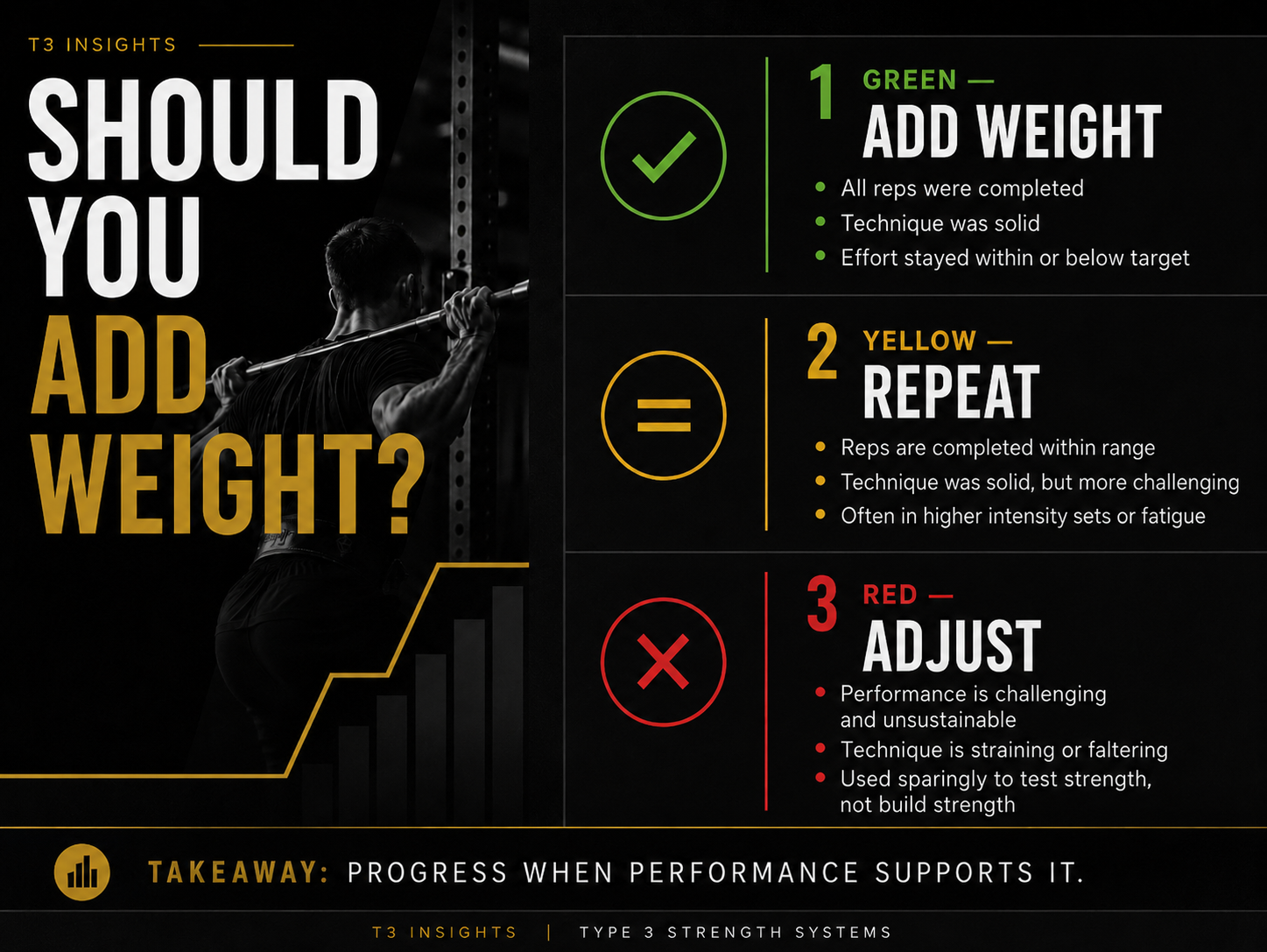
Following a simple roadmap set-to-set can ensure you are making proper progress week-to-week.
The Bigger Picture
Strength training is a long-term process.
The objective isn't to put more weight on the bar at every opportunity.
The objective is to continually provide a training stimulus your body can adapt to.
Sometimes that means adding weight.
Sometimes it means performing another repetition.
Sometimes it means repeating last week's load with dramatically better execution.
And sometimes the best decision is to reduce the load today so you can continue progressing tomorrow.
The number on the bar is one measure of progress. It isn't the only one.
At Type 3 Strength Systems, we use performance, technique, training intent, and individual readiness to determine when progression makes sense.
Because the goal isn't simply to lift heavier.
It's to keep getting stronger.