
Does Weight on the Bar Really Matter?
And What Actually Drives Strength and Performance
Walk into almost any gym and progress is judged the same way:
How much weight is on the bar?
While external load matters, it’s only one piece of a much larger performance puzzle. Strength, adaptation, and long-term success are driven by force requirements, intent, fatigue management, competency, and repeated exposure, not just heavier plates.
Weight matters—but not in the way most people think.
Weight Is a Proxy, Not the Stimulus
From a physiological standpoint, muscles and motor neurons do not recognize “weight.” They respond to force requirements, mechanical tension, and neural demand. External load is simply one way to create those demands.
Muscles do not know the weight of the bar. They only respond to the force required to move it!
Force can increase without the bar getting heavier. Improvements in coordination, leverage, intent, and neuromuscular efficiency can all raise force output while external load stays the same. This is why early strength gains—especially in developing athletes—often occur rapidly before muscle size or maximal loads increase meaningfully.
Relative intensity systems (sets, reps, and percentage ranges) work not because they chase maximal load, but because they reliably expose athletes to sufficient force demands across time.
When Weight Does Matter
Load becomes increasingly important as athletes progress. Heavier weights generally require higher force outputs and greater neural recruitment, which is why maximal strength cannot be developed without eventually lifting heavy loads.
However, this does not mean load must increase constantly.
Strength development is not linear. There are phases where progress shows up as:
Better control of the same weight
Faster bar speeds at similar loads
Higher repetition capacity at the same percentage
Reduced fatigue from the same training stress
All of these reflect meaningful adaptation—even if the plates stay the same.
Competency Changes the Force Equation
Two athletes can lift the same load and experience completely different internal stresses. The difference is often competency.
As technique improves, force is applied more efficiently. Less energy is wasted through unnecessary movement, and more force is directed toward the task. Small changes in joint position, bar path, or posture can dramatically alter moment arms and force requirements without changing load at all.
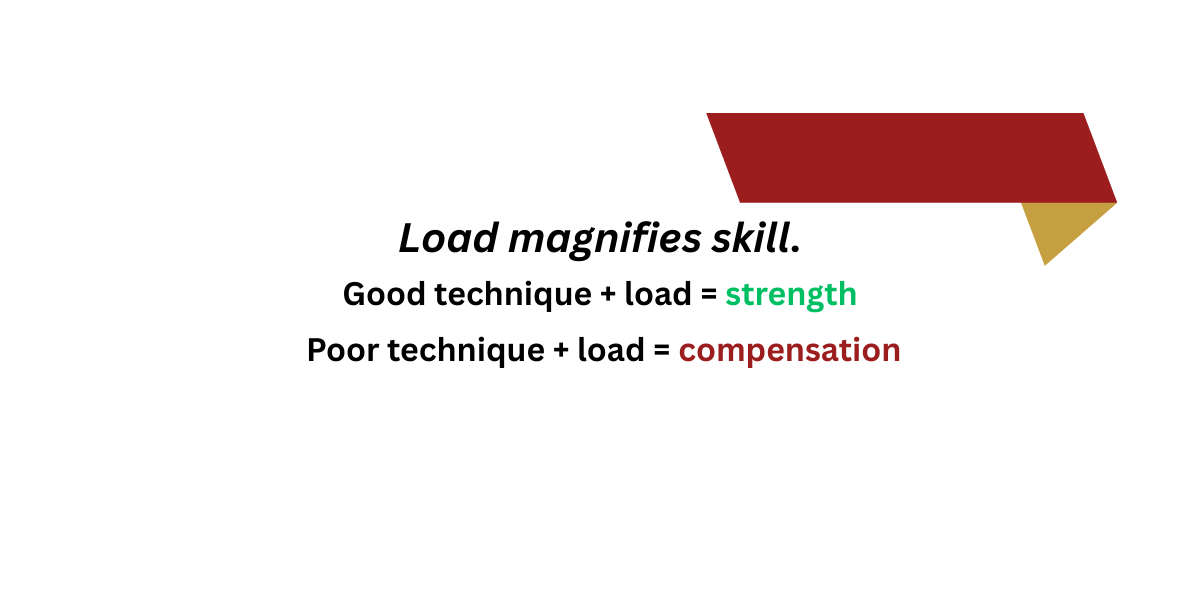
Load magnifies skill!
This is why experienced coaches prioritize movement quality before aggressively chasing heavier weights. If competency is missing, adding load does not improve strength—it simply amplifies inefficiency.
The Repeated Bout Effect: Why Load Plateaus Aren’t Failure
One of the most misunderstood concepts in training is the repeated bout effect. When the body is exposed to the same stress repeatedly, it becomes more efficient at handling it. Muscle damage decreases, soreness is reduced, and recovery improves.
This is adaptation—not stagnation.
The problem arises when load is treated as the only progression variable. If the bar must always get heavier to signal progress, athletes are often pushed to increase load before the system actually needs it.
Progress requires any type of stimulus, not only load.
Progression can occur through changes in volume, proximity to failure, execution, tempo, or density—often more safely and effectively than simply adding weight.
Intent and Neuromuscular Efficiency Matter as Much as Load
Force production is not just about how much force is produced, but how quickly and how effectively it is produced. This is where intent and neuromuscular efficiency come into play.
Two athletes may lift the same load, but the one lifting with maximal intent—attempting to move the bar aggressively—will recruit more motor units and generate a stronger neural stimulus. Over time, this improves the athlete’s ability to express force on demand.
Experienced lifters often lift maximal loads at slower velocities, not because they are weaker, but because they can sustain force output closer to their true limit.
Strength is force expressed under pressure!
This explains why submaximal loads lifted with high intent can meaningfully contribute to strength development, especially when fatigue or readiness limits maximal loading.
Fatigue, Readiness, and Why Load Can Be Misleading
Load does not exist in a vacuum. Sleep, nutrition, stress, and accumulated fatigue all influence how much force an athlete can express on a given day.
A weight that is “light” on paper may represent a maximal effort under poor recovery conditions. Conversely, a heavier weight may move easily when readiness is high.
If readiness drops, load becomes a poor indicator of effort
This is why modern programming incorporates tools like RPE, velocity awareness, and readiness assessments. These tools do not replace load—they contextualize it.
Training stress only leads to adaptation when recovery capacity can support it.
Proximity to Failure Often Matters More Than Absolute Load
Research consistently shows that how close a set is taken to failure strongly influences stimulus. A lighter load taken closer to failure can impose similar force demands as a heavier load performed far from failure.
This does not mean heavy loads are unnecessary. It means load and effort must be considered together.
Perceived effort is often a greater indicator of stimulus than absolute loading
Strength and hypertrophy are not maximized by chasing extremes, but by managing effort, fatigue, and exposure over time.
So… Does Weight on the Bar Matter?
Yes—but only in context.
Weight is a useful tool. It is measurable, repeatable, and often reflective of improved force capacity. But it is not the stimulus itself, nor the only marker of progress.
True strength development shows up as:
Greater force production
Better execution
Improved fatigue tolerance
More consistent performance
Long-term resilience
Loading is part of a larger story!
If you want strength that transfers and lasts, you don’t chase plates—you build systems.
Practical Ways to Progress Strength Without Adding Weight
Strength does not always require heavier loads. Below are practical methods coaches and athletes use to increase force output, training stimulus, and long-term progress—without adding weight to the bar. Each of these represents a standalone concept that can be utilized in your programming.
1) Perceived Exertion (RPE / RIR)
Adjusting how close a set is taken to failure changes force demands without altering load. Training closer to technical or muscular limits increases stimulus while allowing load to remain stable.
2) Bar Speed and Velocity Expression
Improvements in bar speed at the same load often reflect increased neuromuscular efficiency and rate of force development—key drivers of strength progression.
3) Volume Progression (Sets or Reps)
Increasing total work through added sets, additional reps, or more weekly exposures raises training stimulus without increasing external load.
4) Improved Technical Efficiency
Better positioning, bracing, and bar path reduce force leakage and allow athletes to express more usable strength at the same weight.
5) Intent and Aggressiveness of Execution
Maximal intent increases motor unit recruitment even when visible bar speed does not change, enhancing neural adaptation.
6) Proximity to Failure Management
Strategically rotating sets closer to or farther from failure influences fatigue and stimulus without requiring heavier loads.
7) Rest Interval Manipulation
Shorter or more structured rest periods can increase session density and challenge force production capacity without altering load.
8) Exercise Variation and Constraint Changes
Changes in tempo, range of motion, pauses, or stance can increase force requirements while maintaining the same weight.
9) Recovery and Readiness Optimization
Improvements in sleep, nutrition, and fatigue management often unlock strength gains without any programming changes.
References
Stone, M. H., et al. (2025). Using Intensity Based on Sets and Repetitions. NSCA Coach.
Zourdos, M. C. (2017–2024). MASS Research Reviews (Volumes 2–8).
Petushek, E., et al. (2026). Competency and Confidence in Qualitative Biomechanical Assessment. JSCR.
McMillian, J. (2025). Train Hard, Recover Smart. NSCA Coach.
Dulin, K., & Hartman, J. (2025). The Art of Recovery. NSCA Coach.
Helms, E. R., et al. (2016–2023). RPE, RIR, and Proximity to Failure Literature.